
Bitcoin doesn’t take Sundays off. It keeps trading through the night and through your cousin’s wedding, and that one stubborn fact shapes which strategies a beginner can actually live with.
Beginners on Xcelerate Trade can start with spot trend following and swing trading, then add range and breakout setups once their risk rules hold up. Scalping, copy trading and bots are worth exploring too, but first through replay, demo and the Academy’s dedicated paths, with position sizing and trading psychology sitting underneath every approach.
I’ve covered crypto markets long enough to see several cycles of euphoria and regret come and go. What strikes me every time is how rarely newcomers lose money because they picked the “wrong” strategy. Far more often they picked one that didn’t suit their schedule or their nerves, and nobody bothered to explain the difference.
So this isn’t a collection of magic setups. Think of it as a map, sketched by someone who has watched plenty of people get lost, showing what a beginner can reasonably try and in what order. Most examples use bitcoin (BTC) and ether (ETH), the two largest crypto assets by market value, because that’s where a beginner’s first trades usually belong.
Why crypto is harder for beginners than other markets
Crypto is harder on beginners than most markets because it never closes and it swings far more violently than a typical stock index. On top of that, the exchange you use can itself become a risk, something a stock investor rarely has to think about.
A trader buying shares in Frankfurt or New York gets a closing bell. They can walk away, sleep on it and look at the chart again in the morning. A crypto trader gets no such break, and a position held over the weekend has to survive hours when liquidity thins out and a single large order can push price much further than expected.
Volatility is the other half of the story. In March 2020, during the first panic of the pandemic, bitcoin lost more than a third of its value in a single session, and many leveraged traders were liquidated before they’d finished their morning coffee. The worst day in the history of the Dow Jones Industrial Average, Black Monday in October 1987, was a fall of about 22 percent.
Then there’s the venue. Mt. Gox, a Tokyo-based exchange that at one point handled the bulk of the world’s bitcoin trading, collapsed in 2014. FTX, then one of the largest crypto exchanges, filed for bankruptcy in November 2022 with customer money still on the platform. People arriving from the stock market tend to treat an exchange as a neutral pipe, and in crypto that assumption has cost some of them dearly.
Economists at the Bank for International Settlements (BIS), the Basel-based institution owned by central banks from around the world, looked at what this has meant for ordinary buyers. Their February 2023 bulletin, built on crypto app data from August 2015 to December 2022, concluded that a majority of app users in nearly all the economies studied had lost money on their bitcoin. The same authors found that after the Terra/Luna collapse of May 2022 and the FTX bankruptcy, large holders sold while smaller retail investors kept buying, and I can’t think of a clearer description of the beginner’s trap.
What Xcelerate Trade offers a beginner crypto trader
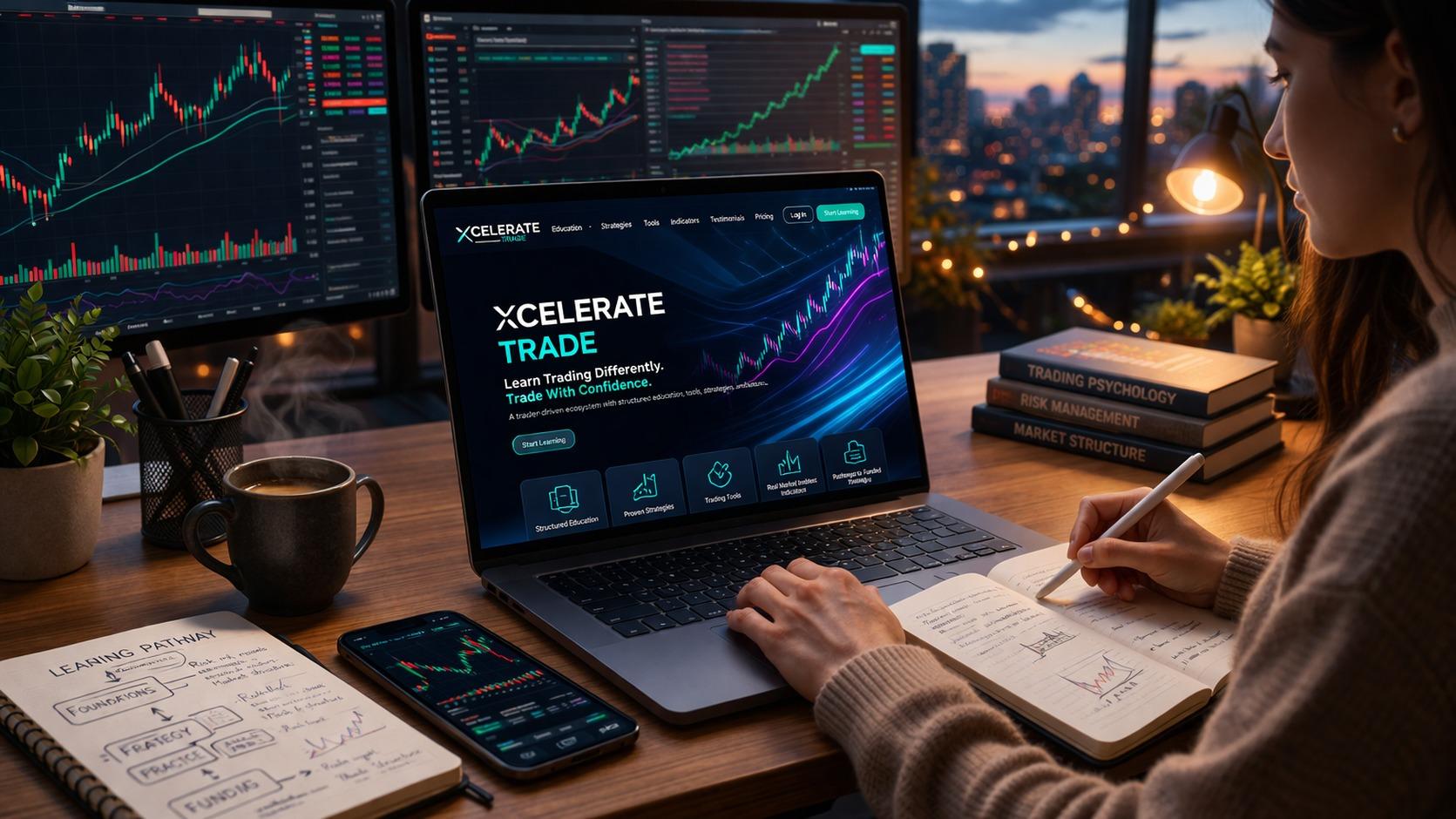
Xcelerate.Trade is an online trading education platform that brings together structured Academy paths, proprietary strategies and indicators, a Practice area with demo trading and replay mode, and a Marketplace for copy trading, with lessons in English, Romanian, Spanish and French. What a beginner gets there is a structure for learning and practicing strategies, not a promise of returns, and frankly I find that reassuring, because anyone promising returns to a beginner is selling something else.
The Academy is divided into paths that map almost one to one onto the strategies discussed here. The Crypto path covers spot markets, wallets, decentralized finance (DeFi), on-chain analysis and perpetual futures, and separate tracks exist for Day Trading, Scalping, Copy Trading, Bot Trading, Risk Management and Trading Psychology. Every path runs through lessons and assessments, which matters more than it sounds, since failing a quiz is about the cheapest way there is to find a gap in your knowledge.
For a newcomer, the Practice section is where the platform really earns its keep. It holds demo trading, replay mode, challenges, prop evaluations and competitions. Replay is the feature I’d point to first, because it moves a historical chart forward one candle at a time and forces you to decide without seeing what comes next.
One thing I’d rather say openly. Some advanced modules and tools unlock through benefits tied to the $XLR token, with membership tiers the platform currently describes as Silver, Platinum and Diamond. Whatever you choose there, keep the token budget apart from your trading capital, in your head and in your spreadsheet, or you’ll never know whether the trading itself works.
Ranking crypto strategies by how forgiving they are to beginners
I rank beginner strategies by how forgiving they are, meaning how much a small mistake in timing, discipline or execution ends up costing. Slow strategies on higher timeframes forgive a lot, while fast ones punish every hesitation and every fee.
This isn’t a ranking by profitability. No one can honestly tell you which strategy makes the most money, since that depends on market conditions and on countless small execution details. What I can tell you is which ones leave room to learn, or at least that’s how it looks from where I sit.
| Strategy | Typical holding time | Screen time it asks for | How forgiving it is | Where to study it on the platform |
|---|---|---|---|---|
| Spot trend following and swing trading | Days to weeks | One or two checks a day | High | Crypto and Risk Management paths, replay mode |
| Range trading | Hours to days | Moderate | Medium | Crypto path, replay mode |
| Breakout trading | Hours to days | Moderate, with price alerts | Medium to low | Day Trading path, replay mode |
| Copy trading as a study tool | Set by the trader you follow | Low, plus a weekly review | Medium | Marketplace, Copy Trading path |
| Bot trading | Continuous | Low to run, high to build well | Low | Bot Trading path, demo account |
| Scalping | Seconds to minutes | Very high | Very low | Scalping path, replay and demo |
Read the table from top to bottom as a rough order of exploration rather than a hierarchy of worth. Some professional traders scalp for a living, and many beginners will never need to.
Trend following and swing trading on spot crypto
For most beginners, trend following on spot bitcoin or ether, using the daily or four-hour chart, is the most sensible first strategy to explore. You buy only what you can pay for in full, you check the chart once or twice a day, and a clumsy entry usually leaves you time to react.
Why higher timeframes suit beginners
Higher timeframes filter out much of the noise. A four-hour candle already contains thousands of individual trades, so one whale order or a stray headline rarely changes the picture on its own. What a beginner gains is time to think before acting.
Swing trading is a close relative. Rather than riding a whole trend, you try to catch one leg of it, usually a pullback into a zone where buyers stepped in before. Positions last days rather than weeks, but the logic of trading with the dominant direction doesn’t change.
What the Turtle traders experiment teaches beginners
In 1983 the Chicago commodity trader Richard Dennis made a bet with his partner William Eckhardt about whether trading could be taught at all. Dennis recruited people with little or no market experience, later known as the Turtles, and handed them a rulebook built largely on breakouts from Donchian channels, a trend-following tool named after the futures pioneer Richard Donchian. Several of them went on to make substantial profits, and trading books still retell the story as evidence that rules can be learned.
What stays with me isn’t the money. The Turtles received rules for exits and position size together with their entry signals, whereas most beginners obsess over entries and improvise the rest.
A worked position sizing example
Say you have a $2,000 account and you’ve decided never to risk more than 1 percent of it on a single idea, which means $20. In this example bitcoin trades at a round $60,000 after pulling back into an area that held twice before, and your invalidation point, the price at which the idea is simply wrong, is $58,800. That’s a 2 percent distance, so the position is $20 divided by 0.02, or $1,000 worth of bitcoin.
The stop decided the size, not your enthusiasm. Had the setup needed a stop 4 percent away, the position would shrink to $500 while the risk stayed at $20. Sizing from the stop is probably the most useful single habit a beginner can take from any Academy lesson.
Range trading when bitcoin goes sideways
Range trading means buying near the bottom of a sideways channel and selling near the top, and it suits crypto because the major coins spend long stretches going nowhere in particular. The catch is that every range ends eventually, usually with a sharp move that hurts whoever bet it would hold.
I’d go as far as saying ranges teach beginners more than trends do. They force you to treat support and resistance as zones rather than exact lines, and to wait for price to come to your level instead of chasing it. They also teach an uncomfortable truth, that the middle of a range is a place where you have no edge at all.
The discipline lives in the stop, placed just outside the range. If you buy the floor at a level that has held three times, the idea is dead the moment price closes convincingly below it. Traders who nudge that stop “just a little lower” are usually the ones who turn a small, planned loss into the big one that ruins the month.
I’d rehearse this strategy in replay mode on Xcelerate Trade before trying it live. Scroll back to any long sideways period on bitcoin, hide the right side of the chart and trade the range bar by bar. You’ll learn quickly whether you buy the floor or panic at it.
Breakout trading and the weekend trap
Breakout trading means entering when price leaves a range or pushes through a clearly defined level, on the bet that the move will continue. In crypto it can work well, but false breakouts are common, especially during thin weekend and overnight hours.
The appeal is easy to see. A breakout often marks the start of a trend, and getting in early feels like catching the train right at the platform. The trouble is that the market has a fair idea where everyone’s stops are, and a quick poke above resistance can trigger a burst of buy orders before price drops straight back into the range.
What helped me make sense of breakouts was separating the break from the confirmation. A candle that closes above the level on a higher timeframe says more than a wick does, and a retest, where price returns to the old resistance and holds it as support, says more still. Waiting means you’ll miss some moves, which is fine, since a missed trade costs nothing.
Watch the clock as well. Crypto liquidity thins out on weekends and in the quieter hours between the US close and the Asian open, and in my experience breakouts in those windows fail more often than the ones that happen while the big trading desks are active.
Scalping crypto as a beginner, study it before you trade it
Scalping means taking many small trades that last seconds or minutes, aiming for tiny price moves on very low timeframes. Beginners can explore it on Xcelerate.Trade, but I’d treat it as something to study in replay and demo long before putting real money behind it.
I’ll be straight with you here. Scalping is the strategy beginners ask me about most and the one I’m least keen to see them start with. It looks effortless in short videos where someone clicks buy, clicks sell and pockets a few dollars, but the clips leave out the hundreds of trades where fees ate the gain.
This is the arithmetic that changed my view of it. Imagine an exchange charging a taker fee of 0.1 percent per side, the fee applied to market orders that remove liquidity from the order book, and a scalp targeting a 0.3 percent move with a 0.2 percent stop. After fees, a winner nets 0.1 percent and a loser costs 0.4 percent, so you’d have to win four trades out of five just to break even.
Now change a single detail. Enter and exit with limit orders at a maker fee of 0.02 percent per side, the lower rate many exchanges charge for orders that add liquidity, and the round trip costs 0.04 percent, which drops the break-even win rate to just under one in two. Same chart, same idea, a completely different business. Fee schedules vary between exchanges and account tiers, so read these numbers as an illustration rather than a quote.
That’s why the Scalping path on Xcelerate Trade puts the weight on reading low-timeframe order flow and keeping risk tight, rather than on quick profits. If you want to see how the platform breaks the subject down, the lessons on Crypto Scalping Strategies are a sensible starting point, ideally with replay mode open in another tab.
Order flow is the part that surprises people. Instead of reading patterns on a candlestick chart, a scalper watches the order book and the tape, the live stream of executed trades, to see who’s getting aggressive and where large resting orders sit. Like any skill, it takes hundreds of repetitions before guesswork starts to feel like intuition.
My rule of thumb is simple. If you can’t yet respect your own stop on a four-hour swing trade, you won’t respect it on a one-minute scalp, where decisions arrive twenty times faster and bring the emotions with them.
Copy trading as a classroom, not an autopilot
Copy trading lets you mirror another trader’s positions automatically, and on Xcelerate.Trade it sits in the Marketplace next to trader portfolios and professional strategies. For a beginner it works best as a way to study how experienced people manage risk, not as a way to hand over responsibility.
The temptation is to sort by highest return and press copy. I’d sort by the depth of the worst drawdown instead, and by how long the trader needed to recover from it. Someone who made 200 percent last year while living through a 60 percent drawdown is showing you a coin flip with good marketing.
What I like to do is copy with a small amount and keep my own notes on every trade the other person takes. Why did they enter there? Where was the stop, and did they respect it when the trade went against them? A month of that teaches more about managing positions than most trading books.
There’s one caveat. A copy trading profile describes a period that’s already over, and a strategy that thrived in a strong trend can bleed slowly once the market turns sideways.
Trading bots and automation for crypto beginners
Trading bots execute a set of rules automatically, and the Bot Trading path in the Academy explains how they’re built and where they fail. A beginner can learn plenty by designing a simple bot, but running one with real money before fully understanding its logic is one of the fastest ways to lose that money.
Grid bots are the textbook case. They place buy and sell orders at fixed intervals inside a range and collect small profits as price bounces around, which works nicely until price leaves the range and the bot keeps buying all the way down. The idea isn’t wrong, it’s a range strategy in a robot costume, with every weakness of range trading plus the risk that nobody is watching.
Dollar cost averaging bots are gentler, and for a lot of readers a plain monthly purchase of bitcoin would fit better than any trading strategy. That’s investing rather than trading. There’s no shame in realizing it’s what you wanted all along.
If you do build a bot, write its rules in plain English first. If you can’t explain in two sentences when it enters and when it stays out, you don’t have a strategy yet, you have a script.
Spot versus perpetual futures, and why leverage can wait
Beginners should explore strategies on the spot market first, where you own the coin and can’t be liquidated, before touching perpetual futures. Perpetuals add leverage, funding payments and liquidation risk, and together those turn small analytical mistakes into account-ending ones.
A perpetual future is a contract that tracks a coin’s price without an expiry date. To keep it anchored to the spot price, exchanges use a funding rate, a periodic payment between long and short holders that slowly eats into a position held for days. In my experience, beginners tend to notice funding only after they’ve paid it for a week.
Leverage is the bigger problem. At ten times leverage, a 10 percent move against you would erase your margin entirely, and in practice the exchange closes the position before that point because it keeps a maintenance buffer. Bitcoin fell by more than a third in a single day in March 2020, so a 10 percent move is far from theoretical.
Europe’s securities regulator reached a similar conclusion years ago. When the European Securities and Markets Authority (ESMA) restricted contracts for difference (CFDs) for retail clients in 2018, it capped leverage on crypto CFDs at 2 to 1, the lowest limit of any asset class. ESMA based the intervention on analyses by national regulators showing that between 74 and 89 percent of retail CFD accounts typically lost money, and those figures are the reason I tell every beginner to learn a strategy without leverage first.
The Crypto path in the Academy teaches perpetual futures as part of its curriculum, which feels like the right approach to me. Leverage is worth understanding in depth long before you decide whether to use it.
Risk management rules that apply to every crypto strategy
Whichever strategy a beginner explores, survival comes down to the same few things, how much you risk per trade, where your stop sits and how you behave during a losing streak. The Risk Management and Trading Psychology paths on Xcelerate.Trade exist because strategy alone rarely saves a trader.
Start with the arithmetic of losses, because it’s lopsided. Lose 20 percent of an account and you need a 25 percent gain to get back to even. Lose 50 percent and you have to double what’s left, which is why protecting capital early matters far more than growing it quickly.
The research on short-term traders is sobering, and beginners deserve to see it before they start. Brad Barber of UC Davis and Terrance Odean of UC Berkeley, working with Yi-Tsung Lee and Yu-Jane Liu of Peking University, studied day traders in Taiwan from 1992 to 2006 and reported in the Journal of Financial Markets in 2014 that less than 1 percent of them earned returns above the market after fees in a predictable, reliable way. In a 2019 working paper, Brazilian economists Fernando Chague, Rodrigo De-Losso and Bruno Giovannetti followed people who day traded Ibovespa mini index futures for more than 300 days and found that 97 percent of them lost money.
I don’t read those numbers as a reason to give up. To me they show that losing is the default outcome, and that the things you do differently, such as a written plan, a journal and smaller positions, are what pull you away from that default.
Psychology sounds soft until you’ve lived through a revenge trade. You take a loss, feel the itch to win it back at once and double your size on a setup you’d normally skip. A daily loss limit, the point at which you close the platform for the day no matter what, is the cheapest rule you’ll ever write and one of the most valuable.
How to practice crypto strategies without risking real money
The safest way for a beginner to explore any of these strategies is to move from replay to demo to a small live account, and the Practice area on Xcelerate Trade covers the first two stages with demo trading, replay mode, challenges and prop evaluations. Each stage tests something the previous one couldn’t.
Replay checks your decisions against history without any time pressure. Demo trading adds the real-time element, live spreads included, along with a kind of boredom that I’d argue does more damage than fear. Only a small live account shows how you behave once the money is yours, and no simulation can replace that.
Keep a journal from the first day and measure results in R, where 1R is the amount you risked on that trade. A 2R win and a 1R loss mean the same thing on a $2,000 account and on a $200,000 one, so your months become comparable. I’d add a column that simply asks whether you followed your plan, yes or no, because after a while it tells you more than your profit and loss does.
Don’t judge a strategy on ten trades. You need something closer to a hundred before the numbers mean much, and even then, a hundred trades taken during a strong trend say little about how the same rules behave once the trend ends.
The challenges and prop evaluations add a useful twist, since they come with fixed limits on drawdown and daily loss. Trading under somebody else’s limits is a good way to find out whether your own were ever real.
Choosing a crypto strategy that fits your schedule
The right beginner strategy is the one that fits the time you really have, not the time you wish you had. Someone with a full-time job and a family will usually do better with daily-chart swing trades than with anything that needs them glued to a one-minute chart.
Be honest about your calendar. Thirty minutes in the evening is a swing trader’s schedule, and trend following on spot bitcoin or ether fits it well. Two focused hours during the overlap between the European and US sessions make range and breakout trading realistic.
Scalping asks for something rarer, long stretches of uninterrupted attention in the most liquid hours of the day. Few beginners have that. Trying to scalp between meetings is how people end up blaming a strategy for what was really a scheduling problem.
Temperament counts as much as time. Some people can sit through a trade that’s down 3 percent for two days without blinking, while others check their phone every nine minutes. Neither is wrong, but they need very different strategies.
Where I would start if I opened an account tomorrow
If I were starting from zero on Xcelerate.Trade tomorrow, I’d begin with the Crypto and Risk Management paths, then practice spot swing trades on bitcoin and ether in replay mode before opening a demo account. Everything faster would wait until my journal showed I could follow my own rules.
The first month would be almost boring, on purpose. I’d pick one strategy, probably trend following on the daily chart, write its rules on a single page and replay a few dozen historical setups. Only then would I switch to demo, sized exactly as I’d trade with real money, because a demo account with $100,000 of pretend capital teaches all the wrong habits.
Somewhere in the second or third month I’d start reading the scalping and copy trading lessons, not to trade them yet, but to see how faster traders think about order flow and position management. That knowledge feeds back into slower strategies more than you’d expect.
And I’d keep one question in front of me, the one I wish someone had put to me much earlier. Not “which strategy makes the most money?”, but “which strategy can I execute the same way on a bad day as on a good one?” For most beginners the honest answer is slower than they’d like, and that’s perfectly fine.
Frequently asked questions
How much money should a beginner start crypto trading with?
Start with an amount you could lose entirely without it affecting your rent or your savings. Sizing positions from the stop makes even a few hundred dollars workable, although fees and minimum order sizes take a bigger bite out of very small accounts. Before depositing anything, run the demo account at exactly the size you plan to fund, so the numbers you practice with are the ones you’ll live with.
Which cryptocurrencies should a beginner trade first?
Bitcoin and ether are the natural starting points, because they have the deepest order books and usually the tightest spreads. Smaller altcoins can jump or collapse on thin volume, and a stop resting in a thin order book often fills far from where you placed it. Once your journal shows consistent execution on the majors, you’ll have a baseline for judging whether an altcoin setup is genuinely better or just more exciting.
What win rate does a beginner need to be profitable?
That depends on the size of your winners compared with your losers. A strategy whose average winner is twice its average loser breaks even before fees by winning roughly one trade in three, while one that wins and loses the same amount needs more than half its trades to work once costs are included. Tracking expectancy, the average result per trade measured in R, tells you far more than win rate alone, since a high win rate built on small winners and occasional large losses can still drain an account.
Can I lose more money than I deposit when trading crypto?
On the spot market the worst case is losing what you bought, whether through the coin’s price or through the failure of the exchange holding it. With leveraged products the answer depends on the venue and the jurisdiction. ESMA’s 2018 measures introduced negative balance protection for retail CFD clients in the European Union, while crypto derivatives exchanges typically rely on automatic liquidation to close positions before an account goes negative, so read each platform’s terms and remember that a fast market can still push a loss past your planned stop.
Should beginners keep their trading funds in stablecoins?
Stablecoins are how most traders hold a cash position on a crypto exchange, so avoiding them completely is hard. They aren’t risk-free, though, and the collapse of the algorithmic stablecoin TerraUSD in May 2022 showed how quickly a supposed dollar peg can break. A sensible habit is to use large stablecoins backed by regularly reported reserves and to keep only active trading capital on an exchange.
Are technical indicators enough to trade crypto profitably?
Indicators measure things like trend, momentum or volatility, and on their own they don’t add up to a strategy. You still need rules for entering, exiting and sizing a position, along with conditions that keep you out of the market. Most beginners do better with one or two indicators they understand well than with a chart buried under lines.
How long does it take to learn a crypto trading strategy?
Learning the rules of a simple swing strategy takes days. Proving you can execute them consistently takes much longer, usually several months, because results only begin to mean something after a sizeable sample of trades. Replay mode shortens the calendar time, since one evening of replay can cover weeks of historical price action.
Is spot crypto trading the same as investing in crypto?
No, even though both involve buying coins you own outright. Investing usually means holding for years on a thesis about the asset, while trading means entering and exiting on a defined plan over days or weeks, with a stop that tells you when you’re wrong. Many people do both in separate accounts, which keeps long-term holdings safe from short-term impulses.
Do I need to understand blockchain technology to trade crypto?
You don’t need to read code, but you should grasp the basics, such as how a wallet differs from an exchange account, what network fees are and why events like protocol upgrades can move prices. The Crypto path in the Academy covers wallets, DeFi and on-chain analysis for exactly this reason. A trader who knows where their coins actually sit is a safer trader.