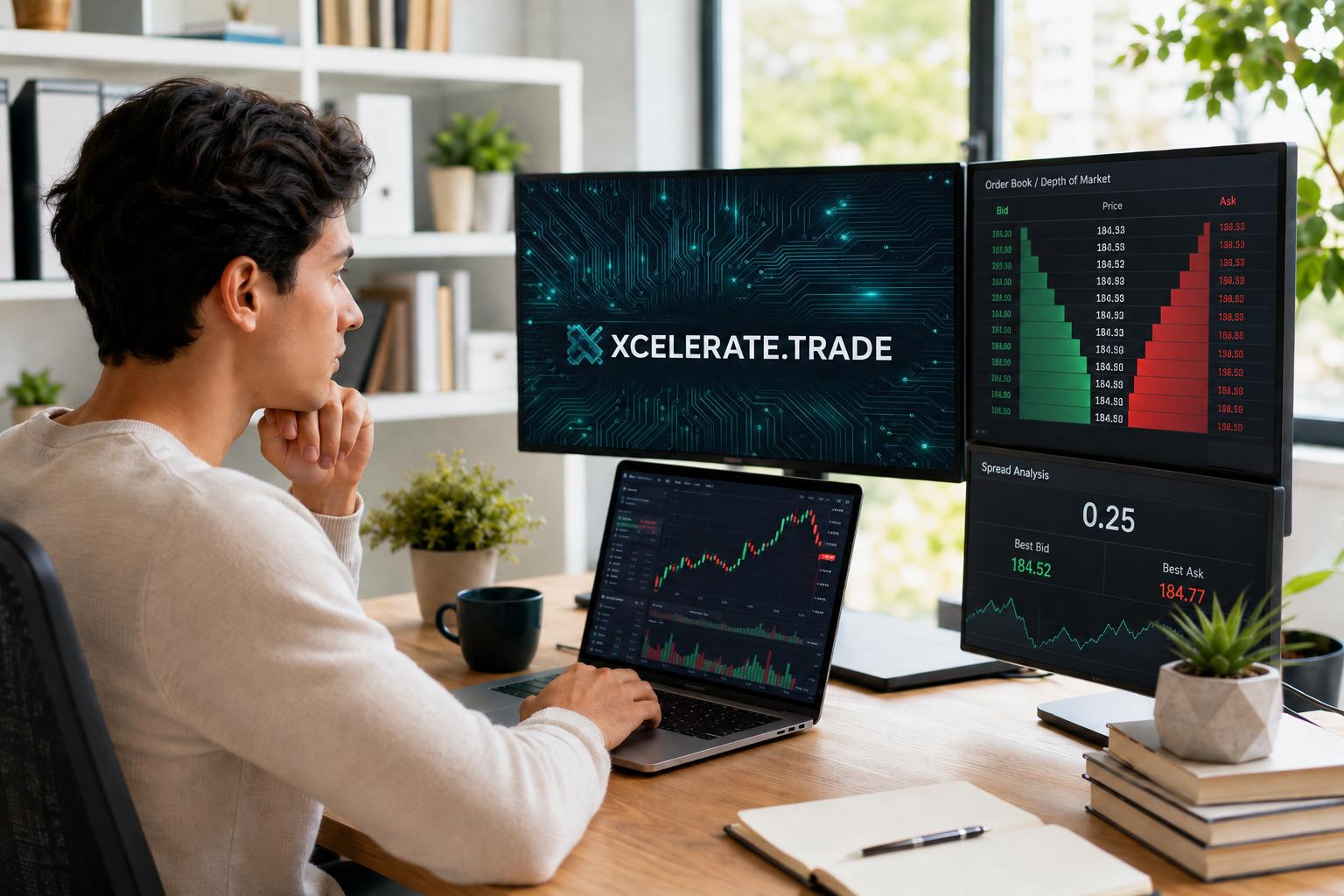

The first time I opened a live position, I lost money in the exact second I clicked buy. Nothing had happened in the market. No news, no dramatic candle, no crash anywhere. My trade simply showed up in the account already slightly negative, and I sat there for a good minute wondering whether the platform was broken.
It wasn’t broken. I had just met the spread, and I met it the expensive way, which is to say without knowing it existed. Almost everyone goes through that moment at some point. The lucky ones go through it on a demo account, the rest of us pay a small tuition fee to the market and remember it for years.
That tiny red number taught me more than a week of videos had. It also convinced me that the three words printed at the top of every quote, bid, ask and spread, are not exam trivia. They are the plumbing of how you get in and out of a position, and they quietly decide which strategies can realistically work for you.
What those two prices on your screen actually mean
Open any instrument on any platform and you see two numbers instead of one. That trips people up, and honestly it should. We grow up with the idea that a thing has a price, singular, the number printed on the tag at the supermarket.
Markets refuse to behave that way. At any given moment there is a price at which someone is willing to buy from you, and a slightly higher price at which someone is willing to sell to you. The first one is the bid, the second is the ask, sometimes called the offer depending on who taught you.
So when EUR/USD shows 1.0850 and 1.0851, that is not a typo or a rounding glitch on your screen. Want to sell euros right now? You get 1.0850. Want to buy them? You pay 1.0851.
The clearest picture I know is the currency booth at the airport, the one with two columns that nobody reads carefully before a holiday. One column is what they give you for your money, the other is what they charge you for theirs. Those columns are never the same, and the gap between them is not an oversight. It is the business model.
Why the bid always sits below the ask
Somebody has to stand on the other side of your order, and that somebody carries risk. When a market maker buys your euros, they are suddenly holding euros they may not want, and the price can move against them while they look for a buyer. The gap between what they pay and what they charge compensates them for that exposure.
Think about a used car dealer for a second. They buy your car at one price, sell it at a higher one, and nobody finds that scandalous. The dealer accepts the risk that the car sits on the lot for three months while demand cools off.
Financial markets run the same logic, except the cars are currency pairs and the lot clears in milliseconds. What makes trading different is that both prices sit right there in front of you, updating constantly, while most beginners look straight past them at the chart.
Saying it out loud once helps. You buy at the ask, you sell at the bid, and you are never on the good side of both at the same time.
The spread is the price of the door, not the ride
Subtract the bid from the ask and you have the spread. In the example above that is 0.0001, which the industry calls one pip. It looks like nothing. It is nothing, right up until you start multiplying it.
Now the part that lands emotionally rather than mathematically. The moment you open a trade you are already behind by the spread, because you bought at the higher price while your position is valued at the lower one. The market has to move in your favour by that amount before you even reach break even.
Which is exactly why my first trade opened in the red. Not punishment, not bad luck, just arithmetic I had skipped. Once you see it that way, the small red number stops feeling personal and starts feeling like a receipt.
Pips, points and the arithmetic nobody bothers to show you
A pip on most currency pairs sits at the fourth decimal, 0.0001. On pairs quoted against the Japanese yen it lives at the second decimal, 0.01, which catches almost everyone off guard the first time. Stocks and indices use points or cents instead, though the underlying logic never changes.
The cash value depends entirely on position size. On a standard lot of 100,000 units, one pip runs to roughly ten dollars. On a mini lot of 10,000 units it is about one dollar, and on a micro lot it drops to around ten cents.
A one pip spread therefore costs you ten dollars on a standard lot before anything at all happens. Two pips on a widely traded pair, which is perfectly ordinary during a quiet hour, doubles that figure. The number that looked like a rounding error suddenly has weight.
Stretch that across a week. Ten round trips a day, one standard lot each, two pip spread, and you have handed over two hundred dollars a day purely for the privilege of participating. Whether that is reasonable or absurd depends completely on what your strategy expects to earn per trade.
Why the spread refuses to stay still
Beginners often assume the spread is a fixed fee, like a bank charge printed somewhere in a contract. It is not. The spread breathes with the market, and learning its rhythm early is one of the more useful things you can do.
Liquidity drives most of it. When plenty of buyers and sellers are active, competition squeezes the gap between the two sides. When the market thins out, the gap widens, sometimes brutally.
EUR/USD during the London and New York overlap behaves nothing like EUR/USD at three in the morning European time. Same pair, same platform, very different cost of entry. I learned that by placing a late night trade once and staring at a spread three times wider than what I was used to seeing.
News does the same thing, only faster and with far less warning. Around a central bank decision or an inflation release, liquidity providers step back because nobody wants to be caught quoting tight prices into a shock. The spread widens for a few seconds or a few minutes, and traders who ignore the economic calendar end up paying for that indifference.
Exotic pairs and thinly traded stocks carry structurally wider spreads for the same reason. Fewer participants, less competition, bigger gap. Someone who wanders into an obscure pair because the chart looked pretty is often paying five or ten times what a major would have cost.
How Xcelerate Trade turns three definitions into something you can feel
Definitions are cheap. You can read what a spread is in fifteen seconds and still not understand it, because understanding here is muscle memory rather than vocabulary. The distance between knowing and feeling is where a lot of beginner accounts quietly die.
What I appreciate about the way Xcelerate Trade structures its learning path is that it refuses to leave these concepts sitting alone as flashcards. Bid, ask and spread appear in the Academy inside a sequence, next to order types, position sizing and risk, which is precisely where they belong. You meet them while learning how a trade is actually placed, not as a glossary entry you skim once.
The lessons move in order, from what you genuinely need before you start, through the mechanics of a quote, into how orders reach the market. That ordering sounds obvious until you notice how much free content online jumps straight to indicators and patterns without ever explaining why a position opens in the red.
There is also value in having the theory and the platform in the same place. Reading about a two pip spread on a blog stays abstract. Reading about it and then watching the number stretch in front of you during a news release is a completely different kind of learning.
Learning the concept before funding anything
The sequence I would give anyone starting out is simple, and it roughly matches what the platform encourages. Understand the quote, understand the cost, then place orders somewhere mistakes are free. Money comes last, never first.
Practice mode exists so your first encounter with the spread costs nothing but attention. You open a position, watch it start slightly negative, and instead of panicking you check the two prices and confirm the difference for yourself. That one exercise, repeated a handful of times, clears out an entire category of confusion.
Xcelerate.Trade also builds in replay, which I think is underrated for this specific lesson. Replaying a session lets you watch how quotes behaved around a particular event, at a particular hour, on a particular instrument. You stop treating the spread as a constant and start reading it as a variable with habits.
The journal that makes cost visible
Here is a habit that changed my results more than any indicator ever did. I began writing down the entry price, the exit price, and separately the spread I paid on every trade. Not the profit. The cost.
After a month the total was uncomfortable to look at. A strategy I believed was mildly profitable turned out to be paying for itself and nothing more, because I was trading too often on an instrument whose spread was too wide for the size of the moves I was chasing. My analysis was fine. My cost structure was the problem.
A journal turns something invisible into something you can argue with. Xcelerate Trade keeps journaling and performance tracking close to the practice environment for that reason, and I would use it from day one rather than day ninety. Beginners tend to assume journals are for advanced traders, which is exactly backwards.
Where the spread quietly decides which strategies suit you
This is the part I wish somebody had told me plainly. The spread is not only a cost, it works as a filter that decides which approaches are realistic for you. Two traders with identical analysis can end up with opposite results purely because of how often they cross that gap.
A scalper aiming for three or four pips per trade is in a knife fight with the spread. If entry costs two pips, more than half the target vanishes before the trade even breathes. That approach can work, though it demands very tight spreads, clean execution and a hit rate most beginners do not have yet.
A swing trader holding for two hundred pips barely registers the same two pips. The cost sits under one percent of the target, which is background noise. Same market, same spread, entirely different significance.
Pick a style first, then check whether the numbers support it, rather than the other way round. When you browse the Forex Trading Strategies section on the platform, read each approach with one question in mind, how many times does this cross the spread, and what does each crossing cost relative to what it is trying to win.
Do that honestly and half the strategies circulating online disqualify themselves in about a minute. Not because they are bad ideas, but because they were built for a cost environment you do not have. That single habit saves beginners more money than any risk rule I know.
Slippage, and the gap between the price you saw and the price you got
The spread has a cousin who shows up right when you least want company. Slippage is the difference between the price you expected and the price you actually received, and it lives in the same neighbourhood as liquidity.
You click buy at 1.0851, the market is moving quickly, and the order fills at 1.0853. Nobody cheated you. The available price at the ask simply changed between your click and the execution, because somebody else got there first.
In calm conditions this barely matters. Around news, at market opens, or in thin instruments, it can dwarf the spread itself. Add two pips of slippage to a two pip spread and a cost you had planned for becomes one you had not.
Beginners often blame the broker, and occasionally that is fair, though usually it is just the market behaving like a market. What helps is not outrage but knowing which conditions produce it and choosing when to be present. That is a decision you can rehearse for free long before it costs you anything.
Reading a quote the way you would read a bill
By this point the practical part almost assembles itself, but let me say it directly anyway. Before any trade, glance at both numbers rather than the chart alone. Ask what you pay to get in, what you receive to get out, and what has to happen for those two to balance.
Then check the hour. Are you trading while the instrument is busy, or while the desk is asleep and quotes have gone lazy? The same setup at ten in the morning and at eleven at night is not the same trade.
Then check the calendar, quickly, without turning it into a ritual. If a major release lands in twelve minutes, you already know the spread will misbehave. Whether you want to be in the market for that is your call, but it should be a call rather than a surprise.
Finally, size the position with the cost included instead of treating it as an afterthought. If you know entry costs roughly ten dollars in spread, that number belongs in the plan next to your stop and your target. Traders who account for cost stop being puzzled about why a break even strategy keeps losing money.
The habit that stayed with me after that first red number
Years later I still glance at both prices before placing anything. It takes half a second and it has saved me from more bad entries than any indicator on my screen. Not because the spread is dramatic, but because checking it forces the question of whether the trade is worth the toll.
What I would say to anyone opening a first account is that the market will teach you these three words either cheaply or expensively, and you get some say in which. Learning them in a structured environment, with a demo account, a replay tool and somebody explaining why the numbers do what they do, is the cheap version. Mine cost real money and a slightly bruised ego.
The bid, the ask and the space between them make up the least glamorous part of trading and, for a beginner, one of the most consequential. Get comfortable with them early and the rest of the learning curve stops feeling quite so steep.
Frequently asked questions about bid, ask and spread
What do bid and ask actually mean on a trading platform
The bid is the price at which the market buys from you, so it is what you receive when you sell. The ask is the price at which the market sells to you, so it is what you pay when you buy. The ask always sits above the bid, and the distance between them is the spread.
Why does my trade open in the red immediately
Because you entered at the ask while your position is valued at the bid, so the difference appears instantly as an unrealised loss. This happens on every platform and every instrument, and it is normal rather than a sign of a bad fill. The market needs to move in your favour by the size of the spread before you break even.
How much does a two pip spread really cost me
On a standard lot of 100,000 units, one pip is worth roughly ten dollars, so two pips costs about twenty dollars at entry. On a mini lot the same spread costs around two dollars, and on a micro lot roughly twenty cents. Multiply that by your number of trades per day and you have your real cost of participation.
Why do spreads widen at certain hours and around news
Because fewer participants are quoting prices at those moments. Outside the London and New York overlap, and in the minutes surrounding a major economic release, liquidity providers pull back to avoid being caught on the wrong side of a sudden move. Less competition between them means a wider gap between bid and ask.
Is a wider spread a sign that an instrument is dangerous
Not dangerous exactly, though it is more expensive and usually less liquid. Wide spreads tell you that few participants are willing to quote, which tends to bring faster moves and more slippage along with it. Beginners are generally better served by heavily traded instruments where being wrong costs less.
Can I avoid paying the spread altogether
No, and any promise that you can should make you suspicious. What you can do is reduce its impact by trading during liquid hours, choosing major instruments, aiming at larger moves and trading less frequently. Cutting frequency is the most underrated option on that list.
How does the spread interact with leverage
Leverage magnifies the cash value of every pip, including the ones you hand over as spread. A one pip spread on a large leveraged position costs real money even though it looks microscopic on the chart. That is why position sizing and cost awareness need to be learned together rather than as separate topics.
Where should a complete beginner practise all of this
Anywhere you can lose nothing while paying close attention. The practice environment inside Xcelerate.Trade is built for that, with Academy lessons sitting beside a simulated account and replay tools. Spend a few sessions doing nothing except observing how the two prices behave at different hours, and the concept stops being theoretical.